

|
By 
Jeremy "JD" Sheehan 
"NOTE THEORY"
-----When you see a note the drum is hit, or stroked. The length of time before you stroke again is determined by the note and
it's value. That value we will measure in beats. The first note is a quarter note and has a value of 1 beat. The next note is
an eighth note, and its' value is 1/2 beat. You will notice that, reading down, the quarter splits up into 2 eighth notes.
Next is the sixteenth note, which has a value of 1/4 beat. Each eighth note splits up into 2 sixteenth notes. Next is the
thirty-second note, which has a value of 1/8 beat. Each sixteenth note splits up into 2 thirty-second notes.
-----All notes in the chart are grouped together into quantities that equal 1 beat. So reading down you have 1 quarter note, 2 eighth notes connected together with 1 beam, 4 sixteenth notes connected together with 2 beams, and 8 thirty-second notes connected together with 3 beams. -----We keep track of time, or the beats, by counting them "1" "2" "3" "4" . Again, notes have value that we are going to measure in beats. Quarter notes, which are equal in value to 1 beat, will be counted 1 - 2 - 3 - 4. Eighth notes will be counted 1-and-2-and-3-and-4-and. Sixteenth notes will be counted 1-e-n-a-2-e-n-a-3-e-n-a-4-e-n-a. In the sixteenth note count, the "e" count is pronounced "ee" such as in the word bee, but without the letter "b". The "n" is pronounced "en" such as in the word ten, but without the letter "t". The "a" count is pronounced "ah", such as the word blah, but without the letters "bl". Thirty-second notes will be counted like eighth notes, 1-and-2-and-3-and-4-and, (because 32nd notes are very fast and you can't count them all). See below for a more detailed explanation of counting thirty-second notes. 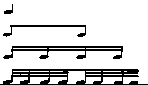
-----So reading across the top line of the note chart, the quarter notes would be counted 1 2 3 4. Move down one line
to eighth notes and they will be counted 1 and 2 and 3 and 4 and. And so on for sixteenth notes. The eighth note count
is placed on the first 32nd note of each 4-32nd note group. So you stroke four times each time you count 1 and 2 and 3
and 4 and. You can also count thirty-second notes with sixteenth note counts, where each sixteenth note count is placed
above every other thirty-second note. So you stroke two times each time you count 1-e-n-a-2-e-n-a and so on.
"RUDIMENTS and the N.A.R.D."
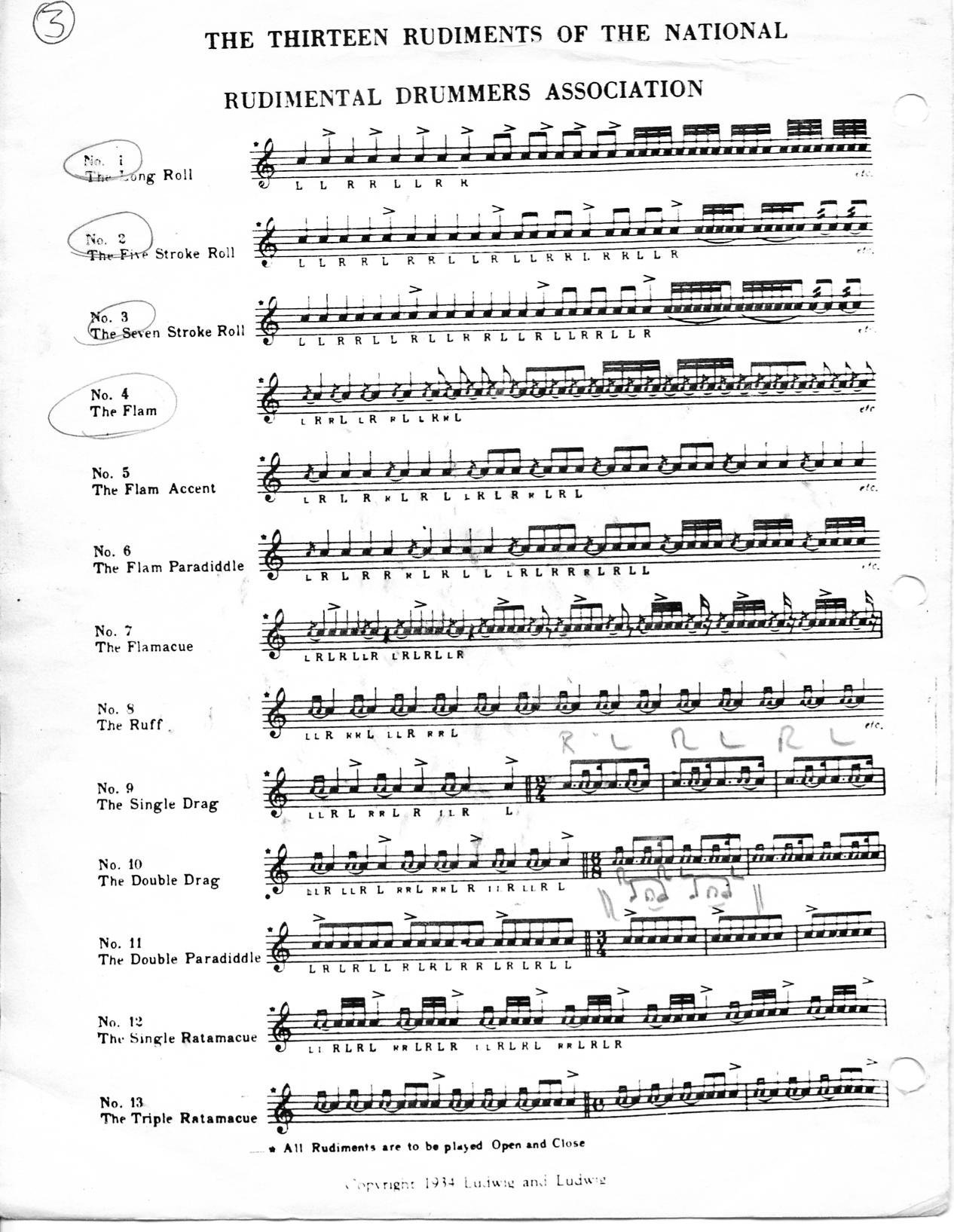
-----The National Association of Rudimental Drummers was formed by a group of drummers in Chicago, Illinios in 1933.
They formulated thirteen basic roll patterns to use as a guide in teaching drum students. These thirteen patterns were
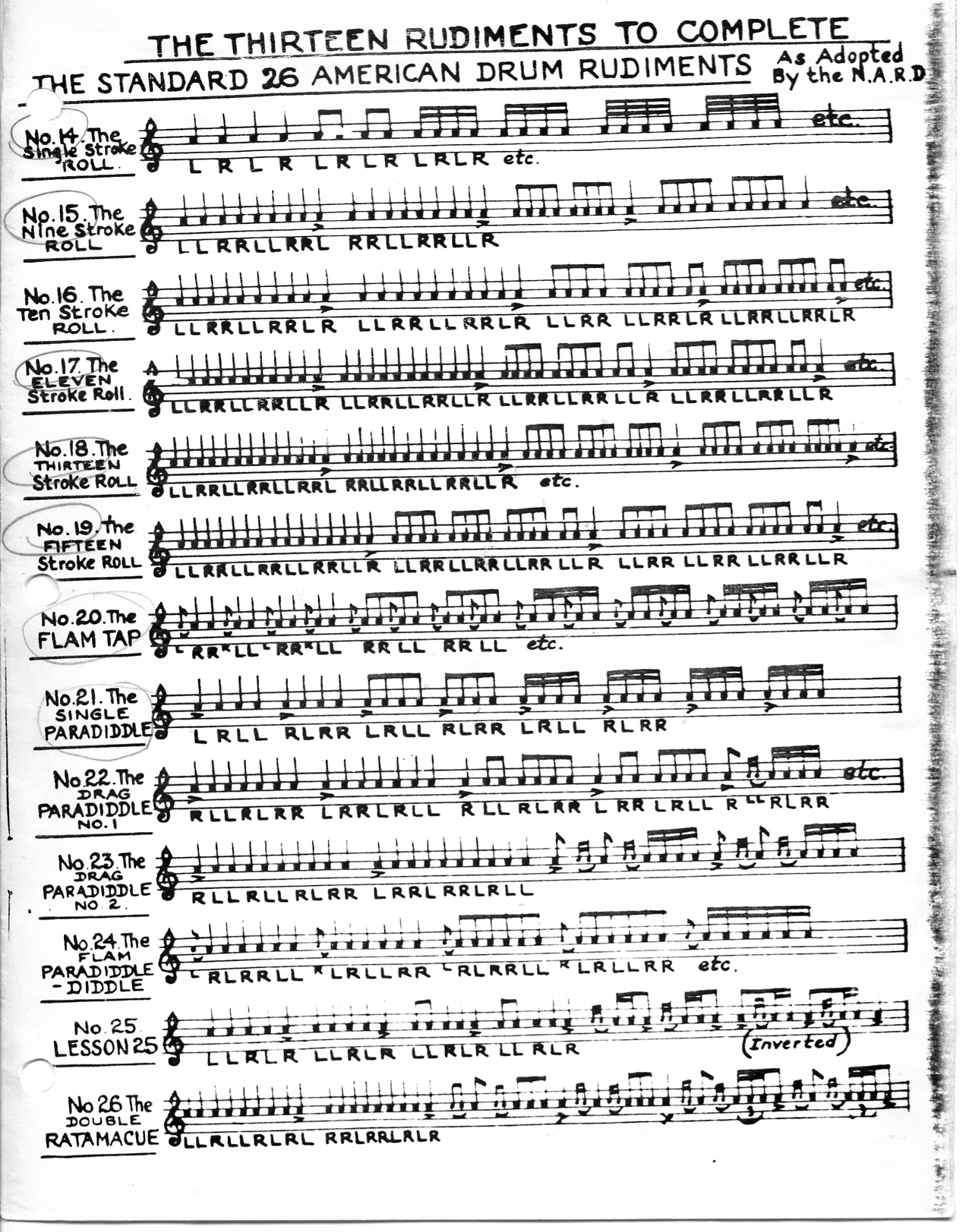
called "The Thirteen Rudiments of the National Rudimental Drummers Association". The total was later brought to twenty-six
when the N.A.R.D. designed thirteen more rudiments, "The Thirteen Rudiments To Complete The Standard 26 American Drum
Rudiments". American public school systems adopted these "rudiments" as the standard for teaching nationwide in the elementary,
high school, and college level drum squads.
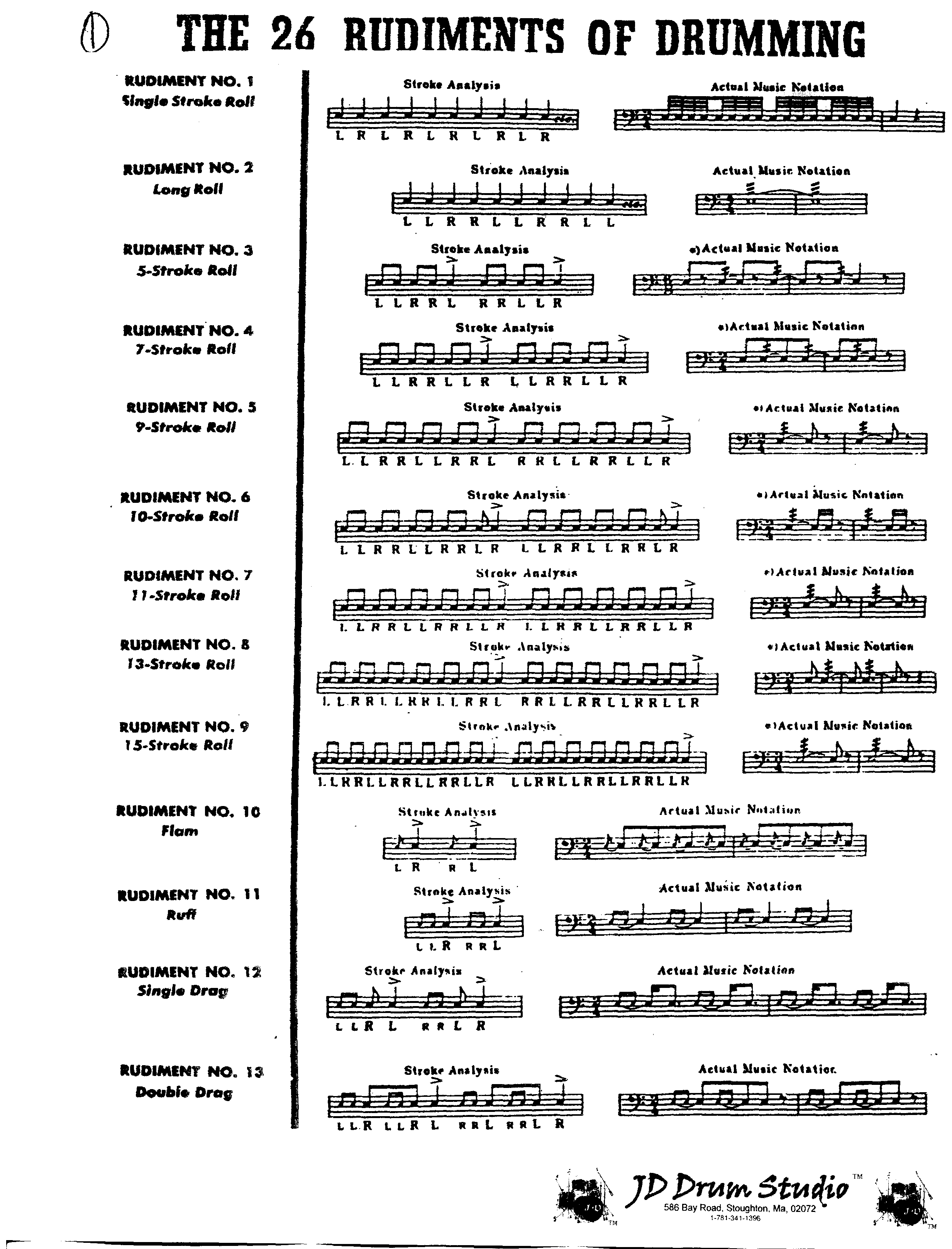
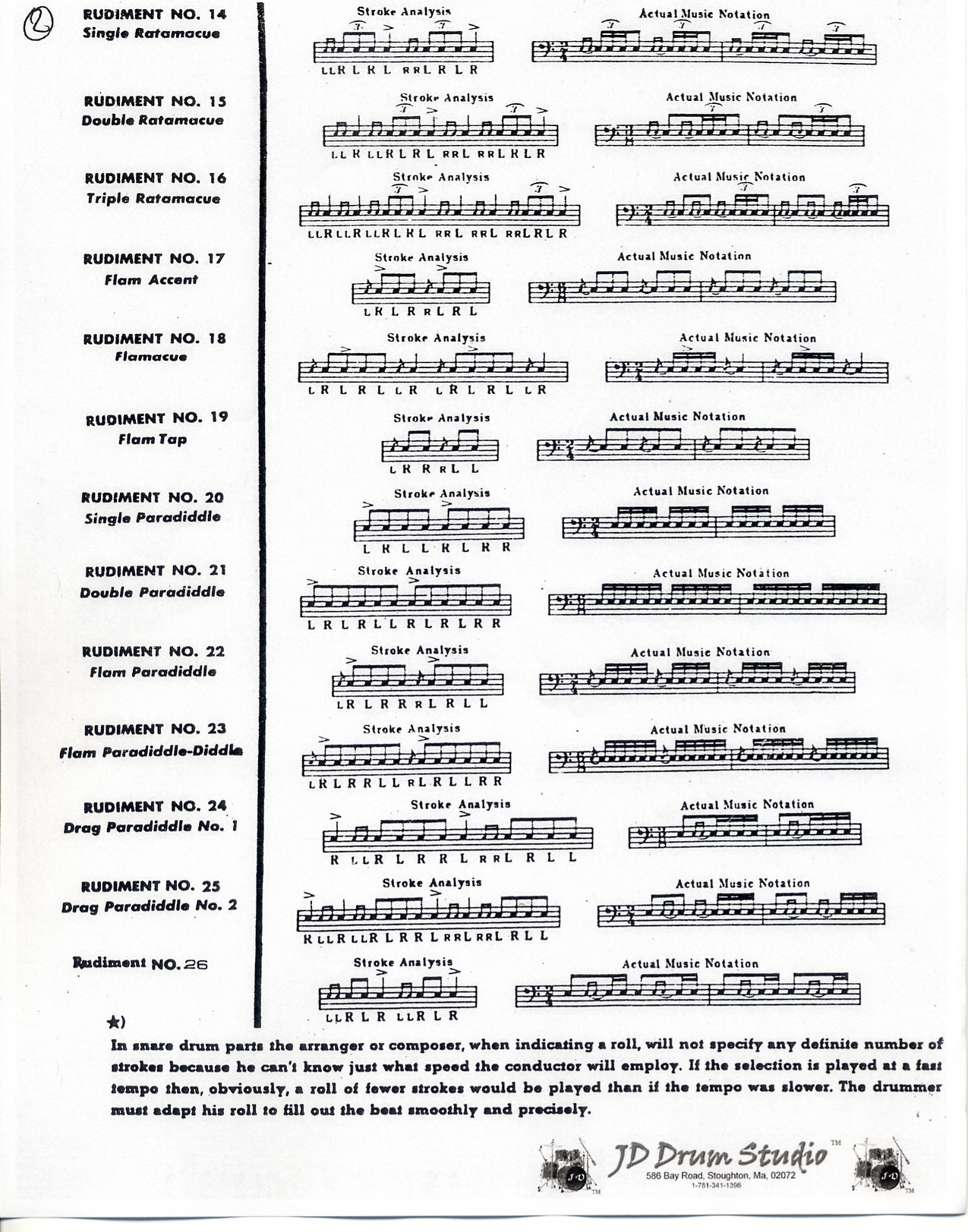
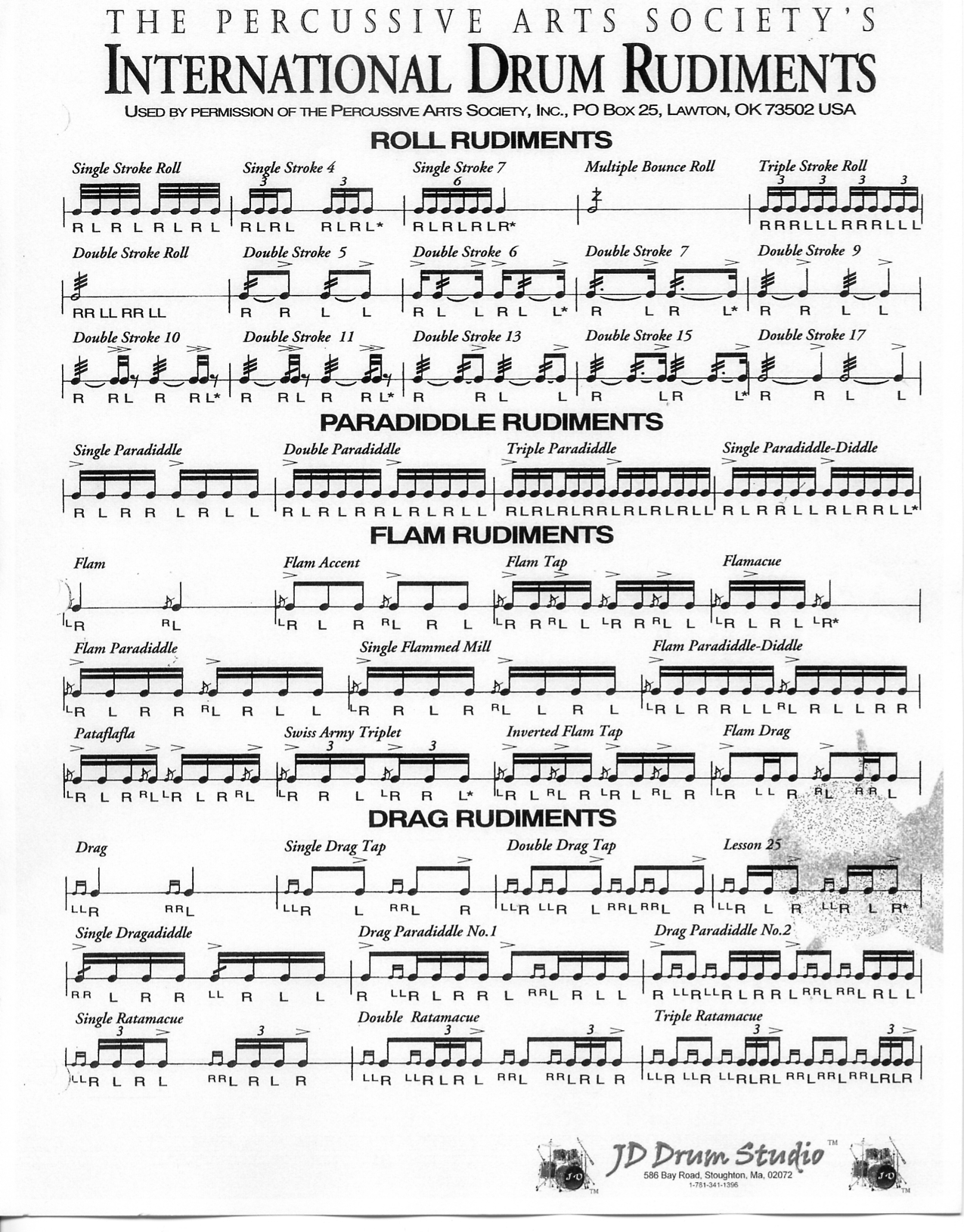
-----The 1st thirteen drum rudiments were combined with the 2nd thirteen drum rudiments and reorganized into a more uniform grouping and called "The 26 Standard American Drum Rudiments". That is why The 1st thirteen rudiments from "The Thirteen Essential Rudiments Of Drumming" and the 1st thirteen rudiments of "The 26 Standard American Drum Rudiments" are not the same. -----The Percussive Arts Society expanded the rudiments to what is know today as "The 40 International Drum Rudiments" and reorganized the rudiments even more into four families. The four families consist of the Roll Family, the Diddle Family, the Flam Family, and the Drag Family. -----For historical purposes, I have included copies of the various rudiment charts which show the evolution and organization of the rudiments from a total of 13 to 26, reorganization of the 26, and from 26 to 40. Under "The 40 International Drum Rudiments" chart is a link to a page that has sound clips of all 40 rudiments. -----The rudiments themselves are different stroking patterns, and the routine for practice consists of manipulating the sticks gradually in a slow to fast to slow fashion. This is also called "open close open" practice. The idea is to train your hands to execute any pattern that the mind imagines. Rudimental practice is neccessary to develope control and coordination, but can also be boring. -----That's where JD comes in! In addition to teaching drumset grooves, I can help you reach the goal of applying rudiments such as the flam, paradiddle, and drum rolls in a creative and musical way to the drum kit! 
Rudiment Sound Clips |
|